
Digital Twin vs Dashboard: What Matters?
If your weekly operations meeting still starts with a dashboard pack and ends with unanswered questions, the issue is rarely the chart design. The real problem in the digital twin vs dashboard debate is that these tools answer very different business needs. One shows what has happened. The other helps you test what is happening now and what is likely to happen next.
That distinction matters when margins are tight, service levels are under pressure, and teams cannot afford to wait another month to understand why performance moved. A dashboard is useful. A digital twin is useful too. But they are not interchangeable, and treating them as if they are often leaves decision-makers with visibility but not control.
Digital twin vs dashboard: the core difference
A dashboard is a reporting interface. It brings together metrics, trends, and visualisations so teams can monitor performance. Good dashboards reduce manual reporting, create a common view of the business, and make KPI tracking faster. They are strong at summarising the past and clarifying the present.
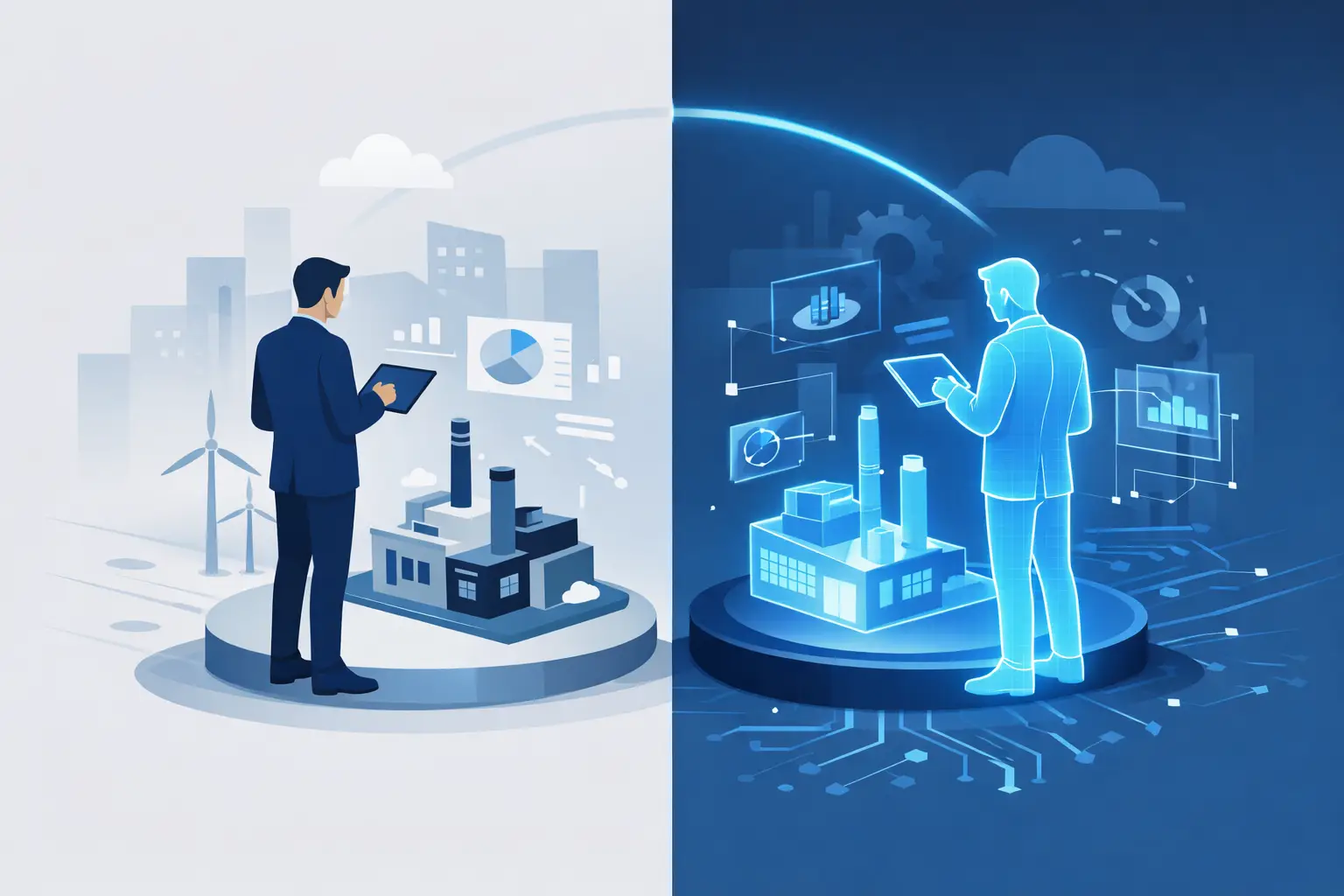
A digital twin is a living model of an operation, process, or system. It connects data from multiple sources, reflects how the business actually behaves, and can be used to simulate outcomes, identify constraints, and forecast what happens if conditions change. It is not just a prettier reporting layer. It is an operational decision tool.
In simple terms, a dashboard tells you that delivery delays increased by 11% last week. A digital twin can help you understand whether the cause was supplier variability, warehouse throughput, staffing gaps, route congestion, or a combination of all four. More importantly, it can show which action is most likely to improve the result.
That is the strategic divide. Dashboards support observation. Digital twins support intervention.
What a dashboard does well
Dashboards remain essential because they solve a real business problem. Leaders need a clear, shared view of performance without waiting for analysts to rebuild the same report in a spreadsheet every Monday. For many teams, that alone is a major step forward.
They are especially effective when the question is stable and the metric is agreed. Revenue by region, stock cover, labour utilisation, patient flow, order backlog, and service response times all lend themselves to dashboard reporting. When teams need fast access to a trusted version of the numbers, dashboards do the job.
They also tend to be easier to deploy. If the data model is straightforward and the KPIs are already defined, a dashboard can provide quick value. That matters for organisations that need immediate visibility before they tackle more advanced analytics.
The limitation appears when the business needs more than a status update. A dashboard can alert you to declining on-time performance, but it cannot always explain the interaction between upstream constraints, external drivers, and likely downstream effects. It presents signals. It does not necessarily represent the system.
What a digital twin changes
A digital twin goes further because it models relationships, dependencies, and operational logic. Instead of displaying isolated metrics, it reflects how parts of the business influence one another.
This matters in environments where outcomes are driven by many moving parts. In manufacturing, production efficiency depends on machine uptime, labour availability, maintenance schedules, material flow, and demand variability. In retail, margin performance can shift due to promotions, replenishment timing, supplier lead times, and local demand changes. In healthcare, capacity pressures emerge from patient demand patterns, staffing constraints, treatment pathways, and discharge timing.
A dashboard can show these signals side by side. A digital twin can connect them.
That connection creates commercial value. Teams can test scenarios before making costly changes. They can assess likely risk before it becomes visible in lagging KPIs. They can move from asking, “What happened?” to asking, “What should we do next?”
For executive teams, this is where foresight starts to replace retrospective management. You stop waiting for the month-end pack to confirm the damage and start acting while there is still time to change the outcome.
Digital twin vs dashboard in real decision-making
The clearest way to compare them is through the decisions they support.
If a regional operations lead wants to know whether service levels missed target last week, a dashboard is usually enough. If the same leader wants to know how to recover service levels over the next three weeks without increasing cost, a digital twin becomes far more valuable.
If a planner needs to review demand trends by product line, a dashboard can provide a quick answer. If the business wants to understand how demand volatility will affect staffing, inventory, and fulfilment under different assumptions, a digital twin is the better fit.
This is why the debate should not be framed as old versus new, or simple versus advanced. It is really about business intent. Are you trying to report performance, or shape it?
That said, there is a trade-off. A digital twin requires stronger data foundations, clearer operational logic, and more discipline around governance. It is not a cosmetic analytics upgrade. If the underlying data is fragmented, inconsistent, or poorly defined, the model will expose those weaknesses quickly.
For serious organisations, that is not a reason to avoid it. It is a reason to build it properly.
Where dashboards fall short
Most dashboard frustration comes from asking them to do work they were never designed to do.
Teams often keep adding filters, tabs, drill-downs, and calculated fields in the hope that enough reporting detail will produce clarity. Sometimes it helps. Often it creates a crowded interface that still leaves users debating causes, assumptions, and next steps. More charts do not automatically create better decisions.
Another common issue is latency. Dashboards may update daily or weekly, but operational risk does not wait for a reporting cycle. By the time a trend is visible, the business may already be absorbing the cost.
Then there is the issue of interpretation. Two managers can look at the same dashboard and reach different conclusions because the dashboard shows outputs, not always the drivers behind them. That slows response, especially in cross-functional settings where operations, finance, supply chain, and commercial teams need to act together.
This is where businesses hit a ceiling with conventional BI. They have visibility, but still lack confidence.
When a digital twin is worth the investment
A digital twin is most valuable when operations are complex, the cost of delay is material, and decisions have knock-on effects across teams. It earns its place where uncertainty is expensive.
If your organisation is juggling fragmented systems, manual spreadsheet workarounds, delayed reporting, and repeated firefighting, a digital twin can create a much clearer operating picture. Not because it replaces every dashboard, but because it turns disconnected data into a model the business can use.
That model becomes especially powerful when paired with forecasting and plain-English explanation. Decision-makers do not just see that risk is rising. They understand why it is rising, what is driving it, and which actions are likely to reduce it.
For many mid-market and enterprise teams, that is the shift that changes behaviour. Reporting becomes less about defending the past and more about steering the future.
Do you need both?
Usually, yes.
This is not a winner-takes-all decision. Dashboards remain useful for tracking agreed KPIs, monitoring operational health, and communicating performance clearly across the business. A digital twin adds a different layer of value by helping teams model scenarios, forecast outcomes, and act earlier.
The strongest analytics environments use both, but with clear roles. Dashboards provide visibility. Digital twins provide foresight. Dashboards support governance and communication. Digital twins support strategy and execution.
That combination is where businesses start to turn uncertainty into advantage. Instead of relying on backward-looking reports alone, teams can see what is changing, understand why it matters, and act with confidence.
For organisations ready to move beyond hindsight, platforms such as AI Grid are built around that shift – harmonising fragmented data, explaining performance clearly, and creating a digital twin that supports faster, better decisions.
Choosing the right next step
If your current reporting stack already gives teams fast, trusted answers to straightforward questions, you may not need to replace it. But if leaders are still asking why performance changed, what will happen next, and which decision carries the least risk, a dashboard on its own is unlikely to be enough.
The better question is not whether a dashboard is good or bad. It is whether your business needs visibility, foresight, or both.
When the pace of change is high, the cost of being late is real, and teams are under pressure to justify every move, hindsight is a weak operating model. The businesses that lead are the ones that build the ability to see around corners.
Related Posts
How to Build Digital Twins That Deliver
A digital twin fails long before the model is wrong. It fails when the business cannot trust the ...

AI Governance for Analytics That Drives Trust
A forecast that cannot be explained will eventually be ignored. An anomaly alert with no clear ow...
8 Ways to Cut Unplanned Downtime Before It Spreads
A production line stops for 20 minutes. A critical pump runs outside its normal pressure range. A...